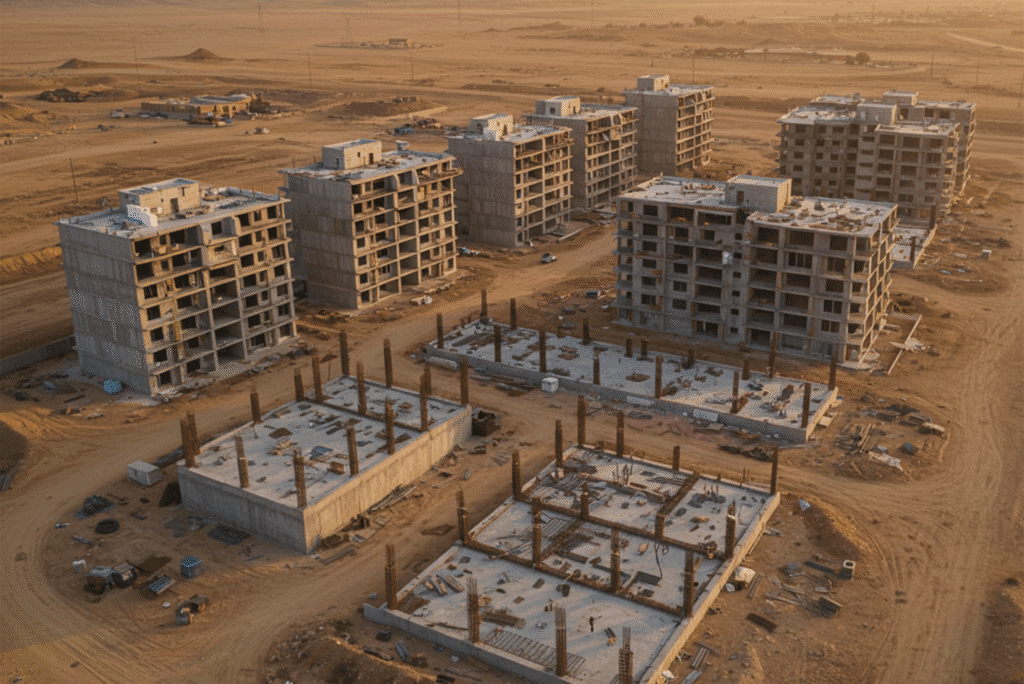
Real estate investment has always been the safe haven for capital and the fundamental pillar for building wealth across generations. In a world where the pace of economic and financial changes is accelerating, real estate remains the only physical asset that combines the characteristics of generating stable income and providing protection against inflation. This vital sector is not merely about buying and selling buildings; it is a science that requires a deep understanding of the market, accurate trend analysis, and a strategic choice of location and timing.
What is the Concept of Real Estate Investment?
Real Estate Investment is the process of purchasing, owning, managing, renting, or selling properties for the purpose of making a profit. These assets include the land, the buildings constructed upon it, and the associated natural resources such as water and minerals.
Real estate investment is not limited to:
Buying a residential apartment for rent.
It also includes:
Buying land for the purpose of development and subsequent sale.
Investing in commercial properties (offices, shops).
Investing in industrial properties (factories and warehouses).
Participating in Real Estate Investment Trusts (REITs).
This type of investment is distinguished by providing two main sources of income: Current Income (rent) and Capital Gain (selling at a higher price after the value increases). A deep understanding of this concept is the starting point for defining your strategy.
How to Invest Your Money in Real Estate?
Investing money in this sector requires more than just liquidity; it demands a clear and deliberate strategy. Here are the most important systematic ways for Real Estate Investment:
1. The Rental Strategy:
Mechanism: Purchasing a property (residential, commercial, administrative) and renting it out to achieve a fixed monthly income.
Advantage: Generates continuous cash flow and provides protection against inflation as rents rise with increasing prices.
Expert Advice: Focus on areas experiencing high rental demand and proximity to essential services and universities.
2. The Buy, Renovate, and Sell Strategy (Flipping):
Mechanism: Buying a property at a low price (often old or in need of repair), comprehensively developing or renovating it, and then quickly selling it to achieve a significant capital profit.
Advantage: Achieving relatively fast profits (usually within 6 to 12 months).
Challenge: Requires expertise in valuation, construction management, and accurately understanding renovation costs.
3. Land Investment Strategy (Land Banking):
Mechanism: Buying land in promising locations (on the outskirts of cities or near future infrastructure projects) and holding onto it for years until its value significantly appreciates.
Advantage: Does not require continuous management or maintenance costs, and is the most effective against long-term inflation.
Risks: Achieving profit may take a long time, and it heavily depends on government decisions related to urban planning.
4. Investing via Real Estate Funds (REITs):
Mechanism: Buying shares in specialized companies that invest in and manage huge real estate portfolios (Real Estate Index Funds).
Advantage: Provides high liquidity and does not require large capital or direct property management. It is the perfect choice for the small investor who wants exposure to the real estate market.
What is the Profit Percentage in Real Estate?
Determining a fixed profit percentage in real estate is impossible, as it depends on the strategy, location, and type of property. However, we can analyze the components of the Return on Investment (ROI):
| Type of Return | Expected Percentage (General Statistics) | Influencing Factors |
| Annual Rental Yield | Usually ranges between 4% to 8% annually of the property value. | Location (commercial/residential), rental demand, maintenance costs. |
| Annual Capital Growth (Appreciation) | Ranges between 5% to 15% annually (especially in developing markets). | Inflation, infrastructure projects, market economic growth. |
| Net Total Return | Typically between 10% to 20% annually in promising markets. | Management efficiency, use of leverage (mortgage loans). |
Applied Example to Deepen Understanding:
If you bought a property for one million pounds and received an annual rental income of 60,000 pounds (6%), and the property’s value increased to 1.1 million pounds (10% growth), the total return is 160,000 pounds (16%) before deducting expenses.
Is Real Estate Investment in Egypt Profitable?
The Egyptian market is considered one of the most active and attractive real estate markets in the Arab region, and the answer to the question: Is real estate investment in Egypt profitable? is “Yes, but with conditions.”
Profitability Factors in Egypt:
Population Growth and Constant Demand: Egypt has high population growth rates, which creates an unceasing demand for residential and administrative units.
Giant National Projects: Government investment in infrastructure and new cities (The New Administrative Capital, New Alamein) significantly raises the value of land and properties surrounding these projects.
Protection Against Inflation: In light of high inflation rates, real estate in Egypt remains the best store of value to protect capital from the erosion of currency purchasing power.
Competitive Rental Yield: Especially in new cities or areas close to major universities, where the rental yield in local currency is high.
Strategic Advice: Success in the Egyptian market depends on the correct timing for buying at the “pre-maturity” stage in new cities, and focusing on properties that meet the needs of the upper-middle class and those capable of paying.
The Best Types of Real Estate Investment
There is no single type that suits everyone, but there are types that usually achieve higher returns and greater stability:
Administrative and Commercial Real Estate (Offices and Shops):
Advantage: Rental yield is significantly higher than residential (may reach up to 10%).
Challenge: Requires larger capital and is directly affected by the general economic situation and commercial activity.
Warehouses, Storage, and Logistics:
Advantage: Demand for them is increasing greatly thanks to the growth of e-commerce, and lease contracts are long-term and stable.
Required Expertise: Good understanding of logistics areas and road planning.
Tourist Real Estate and Short-Term Rentals:
Advantage: Can generate high daily revenues that exceed traditional monthly rent (like hotel apartments).
Challenge: Requires intensive daily management, high-quality insurance, and continuous maintenance.
Student Housing and Private Residential Complexes:
Advantage: Guaranteed and steady demand throughout the year in cities containing major universities.
Pros and Cons of Real Estate Investment
To ensure our view is reliable and in-depth (E-E-A-T), we must clearly highlight the pros and cons:
Advantages of Real Estate Investment:
1. Protection Against Inflation: The value of the asset increases as the currency’s value decreases.
2. Leverage: The possibility of buying a property with a loan (a small part of its price) and using the bank’s asset to generate income, which increases the return on your paid-in capital.
3. Fixed Cash Flow: Monthly income from rents provides continuous financial liquidity.
4. Direct Control: Unlike stocks, the real estate investor has complete control over the asset, its management, and its development.
Disadvantages of Real Estate Investment:
1. Low Liquidity: Selling the property may take a long time (months or even years), unlike stocks.
2. Administrative and Operational Costs: Property maintenance, property taxes, and tenant management costs can be burdensome.
3. Large Capital Requirements: Direct investment in real estate requires relatively large capital as a down payment.
4. Legal and Legislative Risks: Rental or tax laws may change, negatively affecting profitability.
Q: Is investing in under-construction property safe?
A: It is considered safe if the real estate developer has a strong reputation and a proven track record of on-time delivery. It also offers an opportunity to buy the property at a lower price than its price upon delivery.
Q: What is the best time for real estate investment?
A: The best time is “before the price peak” (before the announcement or implementation of a massive project near the property) or during periods when markets experience a temporary decline.
Q: What is the most important document to focus on when buying?
A: You must ensure the validity of the title deed (real estate registration) and the legal licenses for construction and building, to avoid any future disputes.
Investing in real estate is the cornerstone of a successful investment portfolio. We have reviewed the tools, strategies, and market dynamics that enable you to make informed and reliable decisions. Success in this field does not come by chance, but through careful analysis, continuous learning, and patience.
Do not let theoretical information be the end of the line. If you are ready to move from the planning stage to execution, the next step is to determine your optimal location and conduct an accurate property valuation.
Start applying the strategies you’ve learned now, and consult a trusted real estate expert to guide you in local markets, such as the promising Egyptian market. Do not postpone your decision to secure your financial future, as land grows, but it does not multiply.