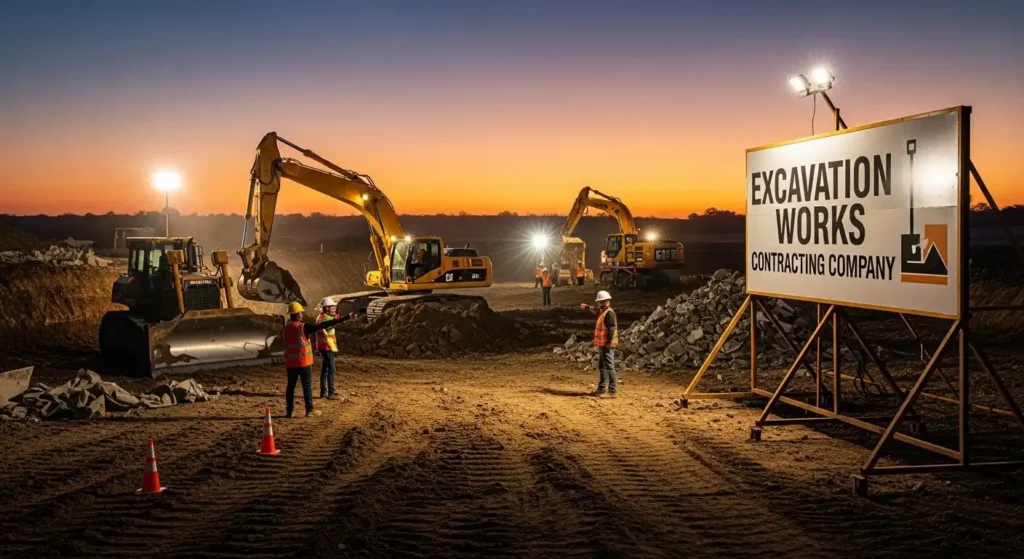
In the world of contracting and construction, excavation works are the cornerstone upon which the success of any engineering project rests, from skyscrapers to complex infrastructure. It is not just about removing soil; it is a precise science that requires deep expertise and uncompromising geological and engineering knowledge.
Are you wondering about the efficiency and reliability required to guarantee the safety and quality of your project’s foundations in Egypt?
Al-Salamoni Company prides itself on being a leader in providing excavation and foundation works services in the Egyptian market, adhering to the highest global safety and quality standards. We offer years of accumulated experience, unmatched reliability (E-E-A-T), and an absolute commitment to delivering work according to precise engineering specifications.
In this comprehensive and detailed article, we will delve deep into the world of an excavation works company for contracting, exploring the technical and procedural aspects that guarantee you a professional achievement, from site handover to the latest global safety rules, emphasizing that “Al-Salamoni” is your ideal partner.
How to Hand Over Excavation Works?
The process of handing over excavation works is a critical and decisive stage to ensure construction begins on a sound foundation. This process is not merely a formality; it is a meticulous inspection that requires the presence of a specialized engineering team, such as the experts available at “Al-Salamoni” Company, to ensure the site conforms to the engineering blueprints.
Key Handover Steps (Al-Salamoni Protocol):
Blueprint Cross-Referencing: Excavation dimensions (length, width, depth) are matched against the approved engineering drawings, and final foundation levels are confirmed.
Soil Nature Verification: The type of soil exposed at the bottom of the excavation is inspected. It must match the geotechnical soil testing report. Should there be a discrepancy or the appearance of unexpected layers (such as rock or groundwater), the consultant is informed to take the appropriate decision (this may necessitate a change in foundation design).
Level Measurement: A level instrument is used with extreme precision to ensure the excavation base level matches the required level, allowing only for a very slight, engineered tolerance margin.
Sloping and Side Stabilization Verification: Necessary slopes for the excavation sides must be confirmed (especially in great depths) to prevent collapse, or the safety of the employed side stabilization methods, such as (concrete diaphragms or shoring), must be verified.
Cleanliness and Dryness: The excavation base must be free of any organic materials, debris, or standing water. Any presence of groundwater must be efficiently addressed by dewatering pumps, a service “Al-Salamoni” provides with specialized expertise.
Signing the Handover Minutes: After verifying all points, the excavation works handover minutes are signed by the site engineer and the consultant’s representative (the supervising authority), signaling the commencement of the plain concrete works phase.
Why choose Al-Salamoni for this stage? We ensure that every cubic meter excavated meets engineering requirements, thereby minimizing the risk of future cracks or foundation settlement.
What is a Contractual Drilling Company?
A Contractual Drilling Company is a specialized entity that provides drilling services as part of a comprehensive or separate contracting agreement. Instead of major corporations or project developers carrying out excavation internally, they contract with a specialized company that possesses the necessary resources, expertise, and equipment for these complex tasks.
Role of a Contractual Drilling Company:
Specialization and Expertise: These companies, such as Al-Salamoni Company in Egypt, possess deep knowledge of local geology, best practices in horizontal and vertical drilling, well drilling, and deep foundation excavation.
Heavy Equipment: Providing a vast fleet of hydraulic excavators, loaders, crushers, and dewatering equipment, which are typically not available to general contracting firms.
Safety and Compliance: Strict adherence to local and international safety regulations (such as OSHA), and managing risks associated with side collapses or exposure to underground utilities.
Types of Drilling Contracts:
Basic Excavation Contracts: Include excavation and disposal of excavation spoils only.
Comprehensive Earthworks Contracts: Include excavation, grading, backfilling, and compaction.
Specialized Foundation Excavation Contracts: Such as drilling piles or retaining walls.
Al-Salamoni is the reliable contractual partner that guarantees the execution of all types of contractual excavation works with unparalleled time and operational efficiency.
What is Excavation Work?
Excavation work includes a wide range of engineering activities aimed at removing soil and rock materials from a specific site to achieve defined levels or to create spaces to accommodate foundations and infrastructure.
Prominent Types of Excavation Works (Al-Salamoni Services):
Foundation Excavation: Preparing the necessary excavations for placing footings, foundations, and concrete, including trenching for retaining walls and excavating separate or combined footings.
Grading Excavation: Removing excess material or filling depressions to reach a unified and level grade for the site before starting construction work.
Trenching: Creating long, narrow openings in the ground for laying utility lines (water, sewage, electricity, telecommunications, gas).
Well Drilling and Deep Foundation Excavation: Requires specialized equipment for drilling foundation piles to great depths to support the heavy loads of massive structures.
Groundwater Dewatering: Managing and controlling groundwater during the excavation process to prevent the collapse of excavation sides and provide a dry, stable excavation base.
Importance of Professional Execution: The proper execution of excavation work ensures the building is stable and protected from settlement or structural damage, which is what “Al-Salamoni” guarantees through a team of long-experienced engineers and equipment operators.
What are Excavation Work Specifications?
Excavation work specifications are subject to strict engineering standards defined in national and international codes (such as the Egyptian Building Code or ACI and ASTM specifications), which are essential to ensure the structural and operational safety of the project.
Most Important Required Technical Specifications:
Dimensions and Levels: The excavation dimensions must perfectly match the engineering drawings, with a very slight tolerance margin. The foundation level is precisely determined based on the soil investigation report.
Quality of Excavation Base: The excavation base must be solid, clean, stable, and free from any soft materials, debris, organic matter, or tree roots.
Sloping and Angle of Repose: Determining the angle of inclination of the excavation sides proportional to the soil type and excavation depth to prevent collapses, or using side protection methods if the excavation is vertical (such as metal sheeting or concrete diaphragms).
Backfilling and Compaction: If backfilling certain areas is necessary, the backfill must be done in layers no thicker than 20-30 cm, with each layer compacted to achieve a dry density ratio of not less than 95% of the maximum density.
Safety Specifications: Specifications must include providing safety measures such as protective barriers around the excavation, warning signs, and safe means of ascent and descent.
Quality Assurance at Al-Salamoni: We use high-precision surveying instruments (Total Station) to verify dimensions and levels, and we are committed to applying the strictest engineering specifications in every contracting excavation operation.
What are the Duties of an Excavation Worker?
The excavation worker is an essential element in any construction project, and their duties extend beyond merely operating heavy equipment. They represent the expert eye on the ground that ensures the engineering plan is executed safely and accurately.
Key Duties and Responsibilities:
Equipment Operation: Highly efficient driving and operating of excavators, bulldozers, and loaders according to the supervising engineer’s instructions.
Executing the Excavation Plan: Adhering to the excavation lines and levels specified in the engineering drawings, and using guide marks and stakeouts to define boundaries.
Daily Safety Procedures: Checking equipment before operation (Pre-operational Checks), ensuring the availability of Personal Protective Equipment (PPE), and assisting in applying site safety procedures.
Monitoring Soil Conditions: Immediately reporting any unexpected changes in soil nature, the appearance of groundwater, or any indicators of instability in the excavation sides.
Disposal of Excavation Spoil: Loading excavation spoil onto designated trucks and transporting it to approved landfill sites.
Basic Maintenance: Performing simple daily maintenance on equipment to ensure work continuity and minimize breakdowns.
At “Al-Salamoni,” we are keen on training our workers according to the highest professional safety standards, which guarantees unparalleled efficiency and accuracy in contracting excavation works.
What is the 5-4-3-2-1 Rule for Excavation?
The 5-4-3-2-1 Rule for excavation is one of the fundamental safety rules related to the safety of workers inside deep trenches and excavations, and it is part of the standards of the US Occupational Safety and Health Administration (OSHA) or its equivalent in other countries. This rule aims to define the minimum requirements necessary for protection against collapse and risk control.
Explanation of the Rule’s Elements:
5 Feet (approx. 1.5 meters): Upon reaching a depth of 5 feet (1.5 meters), a means of protection against excavation side collapse must be provided (such as shoring, supporting shields, or safe sloping), as the risk of collapse becomes extremely high.
4 Feet (approx. 1.2 meters): At this depth, a safe means of ascent and egress (a ladder or ramp) must be provided from the trench.
3 Feet (approx. 90 cm): Excavation spoil piles (Surcharge) must be kept at a distance of no less than 3 feet from the edge of the excavation to prevent them from falling onto workers and to reduce pressure on the excavation sides.
2 Feet (approx. 60 cm): Trenches must be inspected daily by a “competent person” before the start of work, and after any event that could affect the safety of the excavation (such as heavy rain or strong vibrations).
1 Foot (approx. 30 cm): This figure may refer to another standard or be part of a modified safety rule, but it typically focuses on the necessity that no person should stand inside the trench under any suspended load or close to excavation equipment.
Importance at “Al-Salamoni”: We apply these strict rules to ensure the safety of our workers and engineers in all excavation works we carry out, as safety is our highest priority (E-E-A-T).
What is the 10-10-10 Rule?
The 10-10-10 rule is a framework used in strategic decision-making and business management; it is not a direct technical rule in contracting excavation works, unlike the 5-4-3-2-1 rule.
Its Application in Contracting (Al-Salamoni’s Strategic Perspective):
This rule is used to help leaders and decision-makers evaluate the impact of their decisions in the short and long term. When making a decision about a new project or a specific excavation method, we ask the following questions:
What will it look like in 10 minutes? (Immediate Impact): Will the decision cause an immediate delay or safety issue?
What will it look like in 10 months? (Medium-Term Impact): Will the decision affect the workflow, operational costs, or the overall quality of the project?
What will it look like in 10 years? (Long-Term Impact): Does this decision align with our strategic vision, market reputation, and the sustainability of the excavation works company for contracting?
By using this lens, “Al-Salamoni” ensures that its decisions not only serve the current project but also enhance its reliability and expertise in the long term.
What is the 5×5 Rule?
Like the 10-10-10 rule, the 5×5 rule is primarily a management methodology, not a direct technical rule in excavation. It is commonly used as a tool to facilitate presentation and visual communication.
Application in Training and Documentation (Al-Salamoni’s Expertise Perspective):
Presentation Rule: States that there should be no more than 5 lines of text per slide, and no more than 5 words per line.
Objective in Excavation Works: “Al-Salamoni” uses this rule in training its workers and engineers to ensure complex safety instructions and work steps are conveyed clearly and simply, which guarantees a rapid and accurate understanding of essential procedures in excavation work and reduces human error.
What is the 2-2-2 Rule?
The 2-2-2 rule often refers to project management or maintenance practices and can be adapted to suit inspection and documentation procedures in contracting excavation works to increase reliability.
Application in Excavation Inspection (Al-Salamoni’s Quality Methodology):
To enhance quality assurance, “Al-Salamoni” can adopt this rule as follows:
Frequent Inspection (2 Times): Inspecting the site twice daily (morning and evening) to ensure the stability of the excavation sides and the base is free of water.
Dual Documentation (2 Engineers): The excavation works handover minutes must be signed by two different engineers (the company’s engineer and the consultant’s engineer) to ensure no conflict of interest and measurement accuracy.
Emergency Procedures (2 Plans): Having two emergency plans: one for dealing with excavation collapse, and another for dealing with a sudden inflow of groundwater.
These rules, whether direct safety protocols or strategic management frameworks, are what distinguish Al-Salamoni as the best excavation works company for contracting in Egypt, as we combine engineering precision with an absolute commitment to safety.
We have deeply reviewed all aspects related to an excavation works company for contracting, from the technical requirements for work handover to global safety rules like 5-4-3-2-1. Excavation work is not just an initial phase; it is the foundation that guarantees the sustainability and safety of your project for decades to come.
In the Egyptian contracting market, Al-Salamoni Company is the name synonymous with expertise, precision, and adherence to the highest E-E-A-T standards. We don’t just dig the earth; we build long-term partnerships based on trust and guaranteed results.
Do not let the most critical phase of your project fall into the hands of the inexperienced.